
Project
Goals :
Howling Wilds is a team project carried out over 4 months on Tabletop Simulator. The objective was to create a board game for a minimum of 3 players with each game lasting between 15 and 45 minutes. The game was developed by a team of 3 game designers and 3 game artists.
Period :
4 months / February - May 2023
Steam link:
Game Artists:
Ulysse Vanier
Iseline Duniel
Lucas Jacques-Philippe
Game designers:
Theo Birlian
Jean-Philippe Ménier
Alexandre Rollo

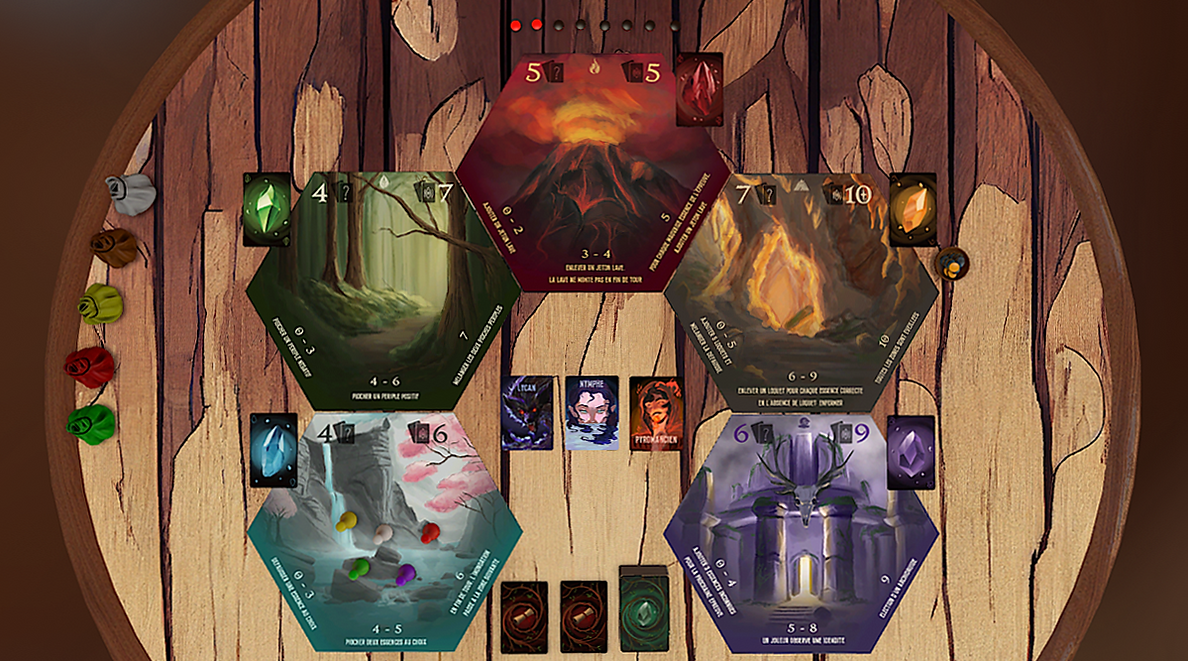
Howling Wilds is a deduction game where players must identify the threat among them. On each turn, players move through five different areas to try to activate their effects. Each occupied zone triggers a trial, forcing the present players to combine their resources in order to win a card draw. However, they must be aware of the threat that can sabotage them.
The game contains three types of threats which all have different victory conditions. Only one threat is randomly chosen per game. The players do not know which one of them is the threat and what type of threat is in play. The threat can reveal itself anytime in the game. When she does, she triggers a powerful effect which gives it a chance to win instantly.
Howling Wilds tests the Druids' abilities to communicate and to demonstrate team spirit. The threat will have to blend into the group in order to sabotage the Druids' efforts without their knowledge.
Concept
Concept
Impulse Shooter is a shooting game that isboth an FPS and a TPS. Each time the player fires, the perspective switches from the view of the shooter to the back of the projectile. The player then has the ability to give asecond projectile impulse in the direction of his choice.
The game level takes place ina wide hallway including targets, transparent walls and boosters, areprocedurally generated. The boosters are objects which, in contact with the player's projectile, allow him an additional impulse.
In Impulse Shooter, players must use precision and strategy to eliminate all targets with an allotted number of impulses.

Sell Sheet

Intentions:
As soon as we were given the projetc's directives, I was thinking about what kind of game I wanted to create. I had keen to create the best possible game and for that I knew that I had to find a good concept to be a part of a good team. My two inspirations were the Loups-garous and the board game inspired by the tv-show Battle Star Galactica. Two games from my teenage years whose qualities and faults I knew well. The objective was to offer a mix of the two, which would correct their flaws and innovate the gameplay. I found that Loups-garous gave players too little impact on the game and made them passive. As for Battle Star, it was its complexity that could diminish the enjoyment of the game. Finding a theme for the game had a real creative click on me. It was when I was able to imagine a group of druids wanting to protect their environment that I was able to design the basics of the game more precisely.
Development


The team:
Once the team was assembled, I insisted that each game designers submitted a concept. I wanted everyone to judge each idea objectively in order to select together the best one. As soon as my concept was chosen we started to improve on it.
We quickly created a prototype to test it with our artists. The group dynamic was good, and we became the minmaxers of our game. It was very useful because balancing of the game was a constant and difficult task. The game having many interrelated elements, each change had a non-negligible impact on everything.
Solutions:
Taking this valuable feedback into account, we came to the conclusion that we had to add a new game mechanic. This is where one of the game designers on my team had a good idea.
Previously, each zone had a positive or a negative effect depending on whether the card draw was successful or not. The druids only had to spend as many cards of the correct category as possible to succeed.
The idea was to add a third effect per zone that would be permanent, powerful and often negative. Players would trigger it if too many positive cards were drawn. This encouraged players to discuss the number of cards that each one of them would play and talk about the chances of obtaining the desired result. I must say that at first I was not convinced of the idea. I still contributed well to the elaboration of the effects and their balancing. The first results tests proved me wrong, and we were all rewarded for implementing the key game mechanic that we needed.
Flaws:
By having the game tested by people outside our team, we noticed several problems. We had such an intention to make it intuitive that, despite its interesting and fun concept, the game was too simple. It lacked replayability.
Finally, the game did not encourage players to communicate. It is not easy to naturally create social interactions with players who, in addition to suspecting each other, are discovering a game.